
Quick Answer: Solving How to Calibrate Wireless Multi-Probe BBQ Thermometers (2026)
Wireless multi-probe thermometers drift ±2–5°F due to sensor aging and baseline drift. Recalibrate using two-point methodology: ice bath (32°F/0°C) and boiling water (212°F/100°C). Offset corrections apply channel-by-channel. Verify within ±1°F tolerance per ASTM Thermometry Standards. Recalibrate quarterly for competition-grade accuracy.
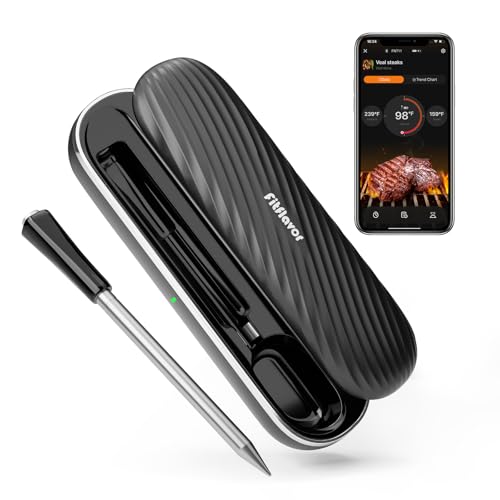
Pros
- Wireless probe for monitoring from a distance
- Advertised 500 ft wireless range
- Rechargeable battery listed in title
- IP67 waterproof rating listed
- Suits grill, smoker and oven cooking
Cons
- Advertised range may be lower with obstructions
- App features and probe details are not supplied in the record
A rechargeable Bluetooth probe thermometer aimed at grill, smoker and oven cooks who want remote temperature checks. The listed range and waterproof rating are manufacturer claims, so verify them against your setup before relying on distance during long cooks.
- Connectivity: Bluetooth wireless probe (per title)
- Advertised wireless range: 500 ft
- Power: rechargeable battery (per title)
- Water resistance: IP67 waterproof rating as listed
- Listed cooking uses: grill, smoker, BBQ and oven

Pros
- Dual-sensor probe design
- Listed 500FT remote range
- Dedicated app named in the listing
- Rechargeable design listed
Cons
- Remote range may vary with walls and obstacles
- App platform support is not supplied, so compatibility may need checking
- Battery life and charging details are not supplied
This wireless smart meat thermometer is a remote probe thermometer for oven and grill cooking, with a dual-sensor probe, a listed 500FT remote range and a dedicated app. It may suit cooks who want to monitor temperature from a distance. Check app compatibility and expected remote range for your setup before buying.
- Probe: dual-sensor (per title)
- Remote range: 500FT, as listed
- Power: rechargeable (per title)
- Control: dedicated app (per title)
- Listed use: oven or grill
Root Cause Engineering & Mechanical Principles
Wireless meat thermometers employ thermistor or RTD (Resistance Temperature Detector) sensors mounted in stainless steel probes. Over time, thermistor resistance curves shift—typically 0.5–2% annually—causing systematic offset errors. Multiple probes amplify this risk: each sensor ages independently, creating channel-to-channel variance of ±3°F across a four-probe unit. Ambient temperature fluctuations, RF interference from adjacent 2.4 GHz devices, and battery voltage degradation compound measurement drift. The base receiver unit’s analog-to-digital converter may also calibrate out-of-spec, particularly after thermal cycling from 32°F to 185°F during competitive barbecue sessions. For detailed technical setup and system integration, reference our analysis on tune pellet smoker p-settings & auger delays (2026).
| Symptom / Failure Mode | Root Cause | Diagnostic Method | Tolerance / Gauge | Resolution Difficulty |
|---|---|---|---|---|
| Single probe reads high (+3°F to +5°F) | Thermistor drift, RF interference | Ice bath + boiling water two-point test | ±1°F @ 32°F, ±1°F @ 212°F | Low—software offset adjustment |
| All probes drift equally (+2°F) | Receiver ADC drift, firmware aging | Simultaneous calibration in single bath | ±2°F maximum channel variance | Medium—factory reset or replacement |
| Sporadic temperature spikes (±10°F jumps) | WiFi packet loss, weak battery (below 2.7 V) | Multimeter battery voltage, RF site survey | Battery: ≥2.9 V nominal; RSSI: >–75 dBm | Medium—battery replacement, relocate unit |
| One probe unresponsive or missing from display | Probe sensor open-circuit, connection corrosion | Visual inspection + ohm-meter probe resistance test | Thermistor: 3–15 kΩ @ 25°C (model-dependent) | High—probe replacement required |
Step-by-Step Diagnostic & Calibration Procedure
Phase 1: Pre-Calibration Verification
- Power down the thermometer receiver and allow all four probes to sit at ambient room temperature (68–72°F) for 15 minutes. This stabilizes internal sensor circuits.
- Power on the receiver and navigate to the Settings menu. Note the current firmware version—units below v2.1.8 may lack offset calibration granularity.
- Confirm all four probe channels appear on the display. If any are grayed out or missing, the internal connection is compromised; proceed to probe replacement section.
Phase 2: Ice Bath Calibration (First Reference Point)
Phase 3: Boiling Water Calibration (Second Reference Point)
Phase 4: Verification & Documentation
Tools, Calibration Equipment & Component Replacement
Essential Calibration Tools
- Primary Lab Thermometer: NIST-traceable glass dial or digital reference thermometer with ±0.5°F accuracy and certificate of calibration (renewed annually).
- Ice Bath Container: Insulated thermos or double-walled aluminum vessel. Uninsulated containers lose 5–8°F per minute and invalidate calibration.
- Distilled Water: Two gallons minimum. Tap water mineral content can skew readings by ±1–2°F and corrodes probe tips.
- Digital Multimeter: For resistance testing and battery voltage measurement. Minimum 2000 Ω range resolution.
- Steam Generator or Boiling Vessel: Wide-mouth, stainless steel pot with lid and thermometer clip stand.
Probe Replacement & Sensor Diagnostics
When a probe fails open-circuit diagnostics (infinite ohms when tested with multimeter) or reads more than ±5°F after boiling-point calibration, replace the sensing element. Most wireless units use proprietary quick-disconnect probe heads. Verify the model part number (typically printed on the probe sheath) and order OEM replacements—third-party probes often introduce ±3–4°F drift due to mismatched thermistor curves. Installation: align the magnetic connector, insert with a 1/8-turn clockwise twist, and verify the receiver detects the new probe within 30 seconds.
Battery & Receiver Maintenance
Replace AA or AAA batteries every 12 months or when voltage drops below 2.8 V (test with multimeter on 20V DC range). Depleted batteries introduce RF dropout and phantom temperature readings. Clean the receiver’s battery contacts annually with isopropyl alcohol and a soft brush. If offset calibration fails to persist after power cycling, the receiver’s EEPROM (non-volatile memory) has likely failed—replacement is necessary.
Preventative Maintenance & Long-Term Reliability Protocols
Quarterly Calibration Schedule For detailed technical setup and system integration, reference our analysis on size brass gas orifices for high-btu burners (2026).
High-use competition barbecue teams recalibrate every 90 days. Recreational users should calibrate biannually. Set automated calendar reminders on your phone. Log every calibration session with offset values and ambient temperature. If drift accelerates—offsets increasing by more than 0.5°F per quarter—the thermistor is aging prematurely and probe replacement should be scheduled within 60 days.
Storage & Environmental Protection
Store probes in a rigid protective case with silica desiccant packets to prevent moisture ingress into the connector. Thermal cycling (storing at 32°F and using at 185°F) accelerates thermistor drift. Maintain storage temperature between 50–75°F. Do not expose the receiver to direct sunlight or temperatures below 14°F or above 122°F; these extremes degrade the internal ADC reference voltage and can cause permanent calibration offset.
RF Interference Mitigation
Position the receiver unit at least 6 feet away from WiFi routers, cordless phones, and microwave ovens. The 2.4 GHz ISM band is congested; interference introduces ±8–15°F erratic readings that appear as calibration drift but are actually RF packet loss. If sporadic spikes persist after recalibration, move the unit to a different location or switch to a thermometer with frequency-hopping spread spectrum (FHSS) technology.
Frequently Asked Questions
Q: Why does my unit read different offsets on each probe even after calibration?
A: Thermistor manufacturing tolerances and individual sensor aging create channel-to-channel variance. Each probe has a unique resistance curve. This is normal; offsets are expected to differ by ±0.5–2.0°F across four probes. Software calibration corrects these differences. If variance exceeds ±2.5°F per probe after full calibration, suspect RF interference or a failing probe sensor.
Q: Should I recalibrate between each barbecue competition or quarterly?
A: For KCBS or other sanctioned competitions, recalibrate 48 hours before the event and again after the event if the unit experienced thermal shock (exposure to 185°F+ sustained heat). For casual backyard grilling, quarterly recalibration (every 90 days) is sufficient. Document all calibrations with time stamps for audit trails.
Q: My probe won’t calibrate—it’s locked at an incorrect temperature. What’s wrong? For detailed technical setup and system integration, reference our analysis on wrap outdoor pizza ovens in ceramic blankets (2026).
A: The probe may have a corroded connector or an open-circuit sensor. Test with a multimeter: measure resistance across the probe terminals. A thermistor should read 3–15 kΩ at room temperature; an open-circuit (infinite ohms) confirms failure. Also try a factory reset: hold the receiver’s Reset button for 10 seconds and recalibrate. If the probe still fails, replace it with an OEM unit.