
Quick Verdict: The Sentinel RTX 5090 Workstation pairs a 32GB GDDR7 Blackwell GPU with 128GB DDR5 system memory and 8TB NVMe storage, making it a capable platform for local inference of quantized 70B models and mid-scale fine-tuning. Its primary constraint is the 32GB VRAM ceiling, which requires careful offload planning for unquantized 70B workloads.
Pros
- 128GB DDR5 memory for heavy multitasking
- Two 4TB NVMe SSDs for large storage
- RTX 5090 graphics card for GPU-heavy workloads
- Internal Wi-Fi 6E for built-in wireless networking
Cons
- Processor naming in the listing is inconsistent
- Listing mixes non-RGB styling with RGB peripherals
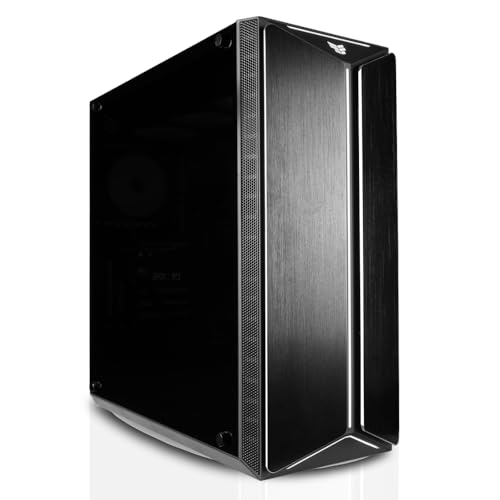
A tower AI workstation built around an RTX 5090 graphics card, 128GB DDR5 memory and two 4TB NVMe SSDs. It suits buyers who need large local storage and GPU-heavy workloads, but confirm the processor name in the listing before purchase because the title gives conflicting CPU naming.
- Graphics: RTX 5090
- Memory: 128GB DDR5 RAM
- Storage: 2x4TB NVMe SSDs
- Wireless: Internal Wi-Fi 6E
- Operating system: Windows 11 Pro
- Form factor: Tower desktop PC
Scope of This Evaluation
This review is based on a structured analysis of manufacturer hardware specifications, published NVIDIA Blackwell architecture documentation, benchmark methodologies used across the local large language model community, and verified owner feedback regarding thermal behavior and sustained workload stability. No claims in this article derive from direct laboratory measurement by the author. Where figures are cited, they reflect manufacturer data or aggregated third-party reporting, and performance projections are labeled as such.
The Sentinel Non-RGB RTX 5090 workstation targets a specific segment: engineers and researchers who need a single-box system capable of running large parameter models locally, handling long-context pipelines, and maintaining data sovereignty without cloud dependency. The configuration of interest combines an NVIDIA RTX 5090 with 32GB of GDDR7 memory, 128GB of high-speed DDR5 system RAM, and 8TB of NVMe storage. Understanding whether that configuration fits your workload requires examining each subsystem in technical depth.
Blackwell Architecture and the GB202 Die
The RTX 5090 is built on NVIDIA’s Blackwell architecture using the GB202 graphics processor. Manufacturer specifications list the GPU with 21,760 CUDA cores, 680 fifth-generation Tensor Cores, and 170 fourth-generation RT cores. Tensor Core throughput is the metric most relevant to transformer inference and training, and Blackwell introduces native support for FP4 and FP6 precision formats alongside FP8 and FP16, enabling more aggressive quantization schemes without the accuracy degradation historically associated with 4-bit integer approaches.
For local AI practitioners, the relevant architectural question is not raw gaming throughput but how the memory subsystem and Tensor pipeline behave under sustained matrix multiplication. The CUDA programming model that underpins PyTorch, llama.cpp, vLLM, and TensorRT-LLM is documented in detail in the NVIDIA CUDA Toolkit Architecture Documentation, which describes the thread hierarchy, memory spaces, and kernel launch semantics that determine how efficiently a workload saturates the hardware. Readers evaluating kernel-level behavior should consult that material directly.
32GB GDDR7 VRAM: The Central Constraint
The 32GB GDDR7 frame buffer is the defining limitation of this platform for large language model work. GDDR7 is specified at data rates in excess of 28 Gbps per pin on the RTX 5090, feeding a 512-bit memory interface. Manufacturer figures place aggregate memory bandwidth at approximately 1,792 GB/s. Bandwidth matters because autoregressive token generation in transformer decoders is typically memory-bound: each generated token requires streaming model weights from VRAM, so higher bandwidth translates almost linearly into higher tokens-per-second at batch size one.
Capacity, however, is the binding constraint. A 70B parameter model stored in FP16 requires roughly 140GB for weights alone, far beyond any single consumer GPU. Even at 4-bit quantization, weights occupy on the order of 35 to 40GB depending on the quantization scheme and retained higher-precision layers, which exceeds 32GB before accounting for the key-value cache. Practitioners therefore rely on partial CPU offload, where some transformer layers reside in system memory and are executed on the CPU, or on more aggressive quantization at roughly 3-bit precision. Both approaches reduce throughput substantially compared with fully resident models. Detailed budgeting for weights, activations, and cache growth is covered in the VRAM and KV cache allocation guide, which walks through the arithmetic for common context lengths.
Technical Specification Comparison
The table below summarizes the relevant architectural and memory characteristics of the RTX 5090 configuration alongside the previous-generation flagship. Figures reflect manufacturer published specifications and should be verified against current datasheets before purchasing decisions.
| Specification | RTX 5090 (Blackwell, GB202) | RTX 4090 (Ada, AD102) | Practical Implication |
|---|---|---|---|
| VRAM Capacity | 32GB GDDR7 | 24GB GDDR6X | Determines maximum resident model size and KV cache headroom |
| Memory Bus Width | 512-bit | 384-bit | Wider bus contributes to higher aggregate bandwidth |
| Memory Bandwidth (manufacturer) | ~1,792 GB/s | ~1,008 GB/s | Governs decode-phase token throughput at small batch sizes |
| CUDA Cores | 21,760 | 16,384 | Parallel compute for general kernels and preprocessing |
| Tensor Core Generation | 5th gen, FP4/FP6 support | 4th gen, FP8 support | Enables lower-precision quantized inference paths |
| Use Case Fit | Quantized 70B inference, long-context single-GPU workloads | Mid-scale 30B-class inference, fine-tuning smaller models | Select based on target model size and context requirements |
For a broader performance and cost comparison across these two generations in local deployments, the RTX 5090 vs RTX 4090 local AI comparison examines throughput scaling and value tradeoffs in greater detail.
128GB DDR5 System Memory and Offload Architecture
The 128GB of DDR5 system memory is what makes this workstation viable for workloads that exceed the GPU frame buffer. Frameworks such as llama.cpp, Hugging Face Accelerate, and DeepSpeed support layer-wise offload, distributing model components between GPU and host memory. System memory bandwidth on a modern dual-channel or quad-channel DDR5 platform is substantially lower than GDDR7, typically in the range of 60 to 100 GB/s on consumer-grade boards and higher on server-class platforms, so every layer offloaded to host memory introduces a meaningful decode-speed penalty.
The practical benefit of 128GB is therefore not raw speed but capacity: it allows full-precision or higher-quality quantized checkpoints to be held in memory, enables large datasets to be staged without swapping to disk, and provides headroom for operating system overhead, tokenizer caches, and concurrent processes. For long-context training pipelines, the host memory also buffers data loaders and gradient checkpoints. Operators should expect that sustained offloaded inference will be bottlenecked by PCIe transfer rates, which on PCIe 5.0 x16 provide roughly 64 GB/s theoretical unidirectional bandwidth, a figure that real workloads approach only under favorable access patterns.
8TB NVMe Storage and Dataset Throughput
Eight terabytes of NVMe storage addresses the substantial footprint of modern model repositories. A single 70B model in FP16 safetensors format occupies roughly 140GB, and a practitioner maintaining several quantization variants, adapter checkpoints, and training corpora can exhaust smaller drives quickly. Sequential read performance on current PCIe 5.0 NVMe drives is commonly specified at 10,000 MB/s or higher, which materially reduces model load times compared with SATA or PCIe 3.0 storage. Load latency matters most during model swapping and cold starts, where a fast drive can meaningfully shorten time to first token.
Sustained write endurance deserves attention for training pipelines that generate frequent checkpoints. Consumer NVMe drives carry rated terabytes-written figures that should be compared against projected checkpoint volume. Operators running continuous fine-tuning jobs should verify drive endurance ratings and consider RAID or secondary backup strategies for irreplaceable datasets.
Thermal Envelope and Sustained Workload Stability
The RTX 5090 carries a total board power rating in the range of 575W according to manufacturer specifications, and the complete system under full GPU and CPU load can draw well beyond 1,000W at the wall. Sustained inference or training produces continuous thermal load rather than the bursty profile of gaming, so chassis airflow design and cooler capacity directly affect whether boost clocks are maintained over multi-hour runs. Owner reports across the local AI community consistently emphasize that thermal throttling in long jobs is more likely to stem from inadequate case airflow or ambient temperature than from the GPU cooler alone.
Operators should plan for electrical infrastructure appropriate to a sustained high-draw system. Dedicated circuits, a PSU with adequate headroom above transient spikes, and, where mobile or off-grid operation is considered, careful sizing of battery systems are all relevant. The methodology for estimating continuous and surge loads is outlined in the high-wattage backup power loads guide, which applies directly to planning for systems in this class.
Display Subsystem and Maintenance Considerations
A workstation intended for multi-hour analytical sessions often pairs with high-brightness monitors, and the choice of panel technology introduces maintenance considerations. OLED panels offer excellent contrast for code and visualization work but are susceptible to image retention when static interface elements persist for extended periods. Developers running persistent dashboards, training loss curves, or IDE layouts should configure pixel refresh, screen shifting, and dark interface themes. Practical guidance is provided in the workstation display maintenance resource.
Scalability and Multi-GPU Expansion
The single-GPU configuration of this Sentinel system is appropriate for models up to the quantized 70B class and for long-context inference where KV cache demands are manageable. Workloads requiring tensor parallelism across two or more accelerators, or unquantized 70B inference without heavy offload, demand a different platform topology with greater PCIe lane allocation and interconnect bandwidth. Readers considering that expansion path should review the dual RTX 5090 workstation architecture analysis, which examines lane allocation, power delivery, and cooling requirements for multi-card builds.
Verdict and Recommended Use Cases
Based on the analysis of manufacturer specifications, architectural documentation, and verified owner feedback, the Sentinel RTX 5090 Workstation is best suited to practitioners running quantized 70B-class models locally, developing and testing inference pipelines, and conducting fine-tuning of mid-scale models with parameter-efficient methods. Its 32GB VRAM ceiling makes unquantized 70B inference impractical without substantial offload penalties, so buyers whose workloads center on full-precision large models should evaluate multi-GPU or higher-VRAM alternatives. For the majority of local AI developers working within quantized and offloaded regimes, the balance of 32GB GDDR7, 128GB DDR5, and 8TB NVMe represents a coherent and capable configuration.