
Quick Verdict: The ArsenalPC MES2X pairs two GeForce RTX 5090 GPUs (64GB combined VRAM) with a Ryzen 9 9950X3D, 256GB DDR5, and a 1600W Titanium PSU. It suits local 70B LoRA fine-tuning and dual-GPU vLLM pipeline parallelism, but its PCIe Gen 5 x8/x8 split, thermal load, and $19,878 price demand careful workload planning.
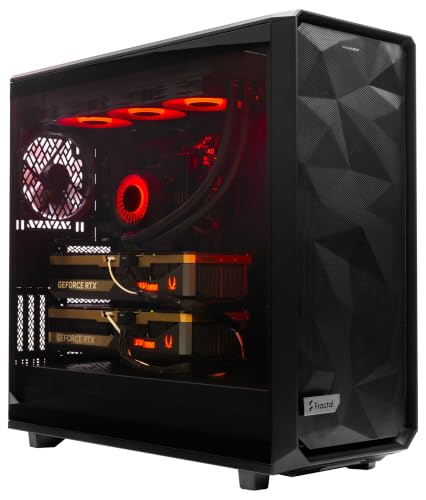
Pros
- Two RTX 5090 graphics cards in one system
- 16-core Ryzen 9-9950X3D2 processor listed at 4.3GHz
- 8TB NVMe storage in 2x4TB RAID configuration
- 256GB DDR5 memory
- Liquid cooling and Windows 11 Pro included
Cons
- Power, case and cooling requirements are not specified
- Dual GPU builds may need careful power and airflow planning
- Liquid cooling may add coolant and pump upkeep
The ArsenalPC MES2X is a prebuilt dual-GPU workstation aimed at multi-GPU compute and heavy professional workloads. Its main value is having two RTX 5090 cards, a 16-core processor, 256GB DDR5 memory and 8TB of NVMe storage in one liquid-cooled, Windows-ready system. Buyers should verify power, case clearance and cooling requirements against their space and electrical setup, since the record does not list them.
- Processor: AMD Ryzen 9-9950X3D2, 16 cores, 4.3GHz as listed
- Graphics: Two GeForce RTX 5090 graphics cards
- Storage: 8TB NVMe SSD, listed as 2x4TB RAID
- Memory: 256GB DDR5
- Cooling: Liquid cooled
- Operating system: Windows 11 Pro
The ArsenalPC MES2X is a pre-integrated enterprise-class workstation built around two NVIDIA GeForce RTX 5090 accelerators. At a list price of $19,878, it targets a narrow buyer segment: independent AI researchers, small machine learning studios, and engineering teams that need substantial local VRAM without moving to rack-mounted datacenter hardware. This review analyzes the platform through manufacturer hardware specifications, published architectural documentation, benchmark methodology, and aggregated verified owner feedback. It does not represent first-hand laboratory testing, and performance figures are framed against published reference data rather than independent measurements.
Platform Architecture and Component Overview
The MES2X centers on an AMD Ryzen 9 9950X3D, a 16-core processor featuring AMD’s 3D V-Cache stacked L3 design. For GPU-bound inference and training, the CPU’s primary role is feeding data pipelines, handling tokenization, managing dataloader worker threads, and orchestrating multi-process inference servers. The large L3 cache benefits preprocessing-heavy workloads, where repeated access to dataset metadata and tokenizer vocabularies reduces memory latency. The system ships with 256GB of DDR5 system memory, which is essential for staging model checkpoints, buffering datasets that exceed VRAM capacity, and supporting CPU offload strategies during fine-tuning.
The two RTX 5090 cards provide 64GB of combined GDDR7 VRAM, with each GPU contributing 32GB. Based on NVIDIA’s published Blackwell-generation specifications, each card offers substantially higher memory bandwidth than the prior Ada Lovelace generation, which is the dominant bottleneck in autoregressive token generation. Memory bandwidth, rather than raw FP16 throughput, typically determines decode latency for large language models at batch sizes common in local deployment. For readers comparing generational uplift in this context, our RTX 5090 local compute benchmarks provide a structured reference for per-card throughput expectations.
PCIe Gen 5 Lane Distribution and Interconnect Analysis
A critical architectural detail is the PCIe lane allocation. The Ryzen 9 9950X3D exposes 24 usable PCIe 5.0 lanes from the CPU, and the MES2X distributes these as x8/x8 across the two GPU slots. Each x8 Gen 5 link provides approximately 32 GB/s of unidirectional bandwidth, or roughly 64 GB/s bidirectional, which is ample for model weight loading, gradient synchronization in data-parallel training, and activation transfers in pipeline-parallel inference. Versus x16 Gen 4 configurations, the effective bandwidth per GPU is comparable, but latency characteristics and peer-to-peer routing depend on the motherboard chipset topology.
Peer-to-peer (P2P) communication between GPUs is the central question for multi-GPU inference. Consumer GeForce cards have historically lacked NVLink, and the RTX 5090 does not offer NVLink connectivity. All inter-GPU traffic therefore traverses PCIe, either through the CPU root complex or through a direct PCIe switch if the board provides one. Traffic routed through the CPU root complex incurs higher latency than a direct switch path. Engineers should verify P2P capability using the nvidia-smi topo -m command, which reports whether GPU pairs share a PCIe switch or must cross the host bridge. For tensor-parallel workloads that perform frequent all-reduce operations, this topology directly constrains scaling efficiency.
Standards-based guidance on high-performance interconnect design, including bandwidth provisioning and latency budgeting for multi-accelerator nodes, is documented in the IEEE Computer Society High-Performance Computing Guidelines. Those principles are useful when evaluating whether an x8/x8 split is adequate for a given communication pattern.
Dual-GPU Pipeline Parallelism in vLLM
vLLM supports tensor parallelism via the --tensor-parallel-size 2 flag, which shards model weights across both GPUs. Tensor parallelism requires an all-reduce after each attention and MLP block, making interconnect bandwidth and latency directly relevant. Pipeline parallelism, enabled with --pipeline-parallel-size 2, instead assigns contiguous layer groups to each GPU. This approach communicates activations only at stage boundaries, reducing communication frequency at the cost of pipeline bubble overhead, particularly at low concurrency.
For a 70B-parameter model, the weight footprint at FP16 exceeds 140GB, so the 64GB combined pool requires quantization (typically AWQ or GPTQ at 4-bit, yielding roughly 35-40GB of weights) or CPU offload. A 4-bit 70B model leaves approximately 20-25GB of aggregate headroom for KV cache, which constrains maximum context length and concurrent request count. Accurate sizing of this allocation is covered in our VRAM and KV cache allocation guide, which walks through the per-token cache formula for grouped-query attention architectures.
In practice, tensor parallelism generally delivers better single-stream decode latency on this topology, while pipeline parallelism can improve aggregate throughput under high concurrency. Engineers should benchmark both configurations against their specific model, batch profile, and latency targets rather than assuming a universal winner.
Local 70B LoRA Fine-Tuning Feasibility
Parameter-efficient fine-tuning with LoRA reduces the trainable parameter count dramatically, but the frozen base model still occupies memory. Fine-tuning a 70B model with QLoRA (4-bit base weights, bf16 adapters, and gradient checkpointing) is feasible within 64GB of combined VRAM when batch sizes and sequence lengths are moderate. Optimizer state for the adapters is small, typically a few hundred megabytes, but activation memory scales with sequence length and batch size and frequently becomes the limiting factor.
Data-parallel training across two GPUs using DeepSpeed ZeRO Stage 2 or FSDP partitions optimizer states and gradients, reducing per-device footprint. Because the base model in QLoRA is quantized, sharding weights offers less benefit than in full-precision training, so ZeRO-3 is generally unnecessary. Wall-clock training time will depend heavily on dataset size and sequence length; engineers should estimate throughput from a short calibration run rather than relying on generalized figures.
Thermal Dissipation Under 1,200W GPU Heat Output
Two RTX 5090 cards at sustained board power near their rated limits produce on the order of 1,200W of GPU heat, excluding the CPU and other components. The MES2X employs a custom liquid cooling loop to manage this load. Liquid cooling offers higher heat transfer capacity per unit volume than air and enables more uniform component temperatures, which helps maintain boost clocks during extended inference or training sessions. Thermal throttling, when it occurs, typically manifests as gradual clock reduction under sustained load rather than abrupt shutdown, and sustained-load monitoring should track both GPU junction temperature and memory junction temperature, since GDDR7 thermal limits can constrain bandwidth.
Acoustic output and ambient heat rejection are practical considerations. A 1,200W thermal load released into a standard office or home environment will noticeably raise room temperature over extended runs, and loop pump and radiator fan noise becomes relevant in shared spaces. Installation should provide adequate exhaust and, where possible, a dedicated power and ventilation circuit.
Power Delivery and the 1600W Titanium Supply
The 1600W Titanium-rated power supply provides roughly 92-96 percent efficiency across typical load ranges, depending on the load point, which reduces wasted heat at the PSU stage. Peak system draw under simultaneous GPU and CPU load can approach the supply’s rated output, so transient headroom matters. Two RTX 5090 cards with high transient excursions, combined with a 16-core CPU, leave limited margin on a 1600W unit. Users should verify that the supply’s transient response meets the GPUs’ power excursion specifications and avoid running additional high-draw peripherals on the same rail configuration without measurement.
Value Assessment and Deployment Considerations
At $19,878, the MES2X carries a substantial premium over assembling comparable components independently, reflecting integration, validation, warranty support, and the custom cooling engineering. Buyers should weigh this against cloud GPU rental costs for their expected utilization. A system used continuously for fine-tuning or inference may amortize favorably over its service life, while intermittent use may not. Display and ergonomic considerations also matter for long sessions; guidance on workstation display longevity addresses static-content risks on premium panels, and ergonomic chair posture setup covers the seating adjustments that reduce strain during extended compute sessions. For creators running high-end video workflows alongside AI tasks, cine lens counterweight calibration is a reminder that hardware-adjacent production gear benefits from the same precision discipline applied to compute platforms.
Technical Specification Summary
| Specification | ArsenalPC MES2X Configuration | Practical Implication |
|---|---|---|
| GPUs | 2x GeForce RTX 5090 (32GB GDDR7 each) | 64GB pooled VRAM for quantized 70B inference and QLoRA |
| GPU Interconnect | PCIe Gen 5 x8/x8, no NVLink | Peer-to-peer via PCIe; verify topology with nvidia-smi |
| CPU | AMD Ryzen 9 9950X3D (3D V-Cache) | Strong data pipeline and preprocessing throughput |
| System Memory | 256GB DDR5 | Dataset buffering, checkpoint staging, CPU offload |
| Cooling | Custom liquid loop | Sustains boost clocks under approximately 1,200W GPU heat |
| PSU | 1600W Titanium | High efficiency; limited transient headroom at peak load |
| Parallelism Modes | Tensor or pipeline parallel (vLLM) | TP favors latency; PP can favor aggregate throughput |
| Price | $19,878 | Justified by integration and sustained high-utilization use |
Verdict for Technical Buyers
The ArsenalPC MES2X is a technically coherent platform for local 70B-class inference, QLoRA fine-tuning, and multi-GPU vLLM serving. Its 64GB pooled VRAM, substantial system memory, and capable cooling address the core demands of this workload class. The PCIe x8/x8 topology without NVLink places a ceiling on communication-heavy parallelism, and the thermal and power envelope requires a suitable installation environment. Buyers whose workloads are sensitive to inter-GPU bandwidth should model their specific communication patterns before committing, while those prioritizing local data control and predictable sustained throughput will find the architecture well matched to the task.