Quick Verdict: For unquantized 70B fine-tuning, a single RTX PRO 6000 Blackwell with 96GB of unified GDDR7 generally outperforms a dual RTX 5090 rig with 64GB of split VRAM. The single card avoids inter-GPU communication overhead, keeps the full KV cache resident in one memory pool, and simplifies model sharding. Dual 5090s retain an edge in raw aggregate throughput for batched workloads that parallelize cleanly.
Pros
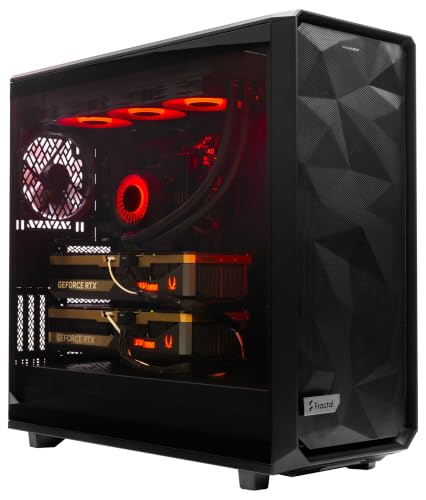
- Two RTX 5090 graphics cards in one system
- 16-core Ryzen 9-9950X3D2 processor listed at 4.3GHz
- 8TB NVMe storage in 2x4TB RAID configuration
- 256GB DDR5 memory
- Liquid cooling and Windows 11 Pro included
Cons
- Power, case and cooling requirements are not specified
- Dual GPU builds may need careful power and airflow planning
- Liquid cooling may add coolant and pump upkeep
The ArsenalPC MES2X is a prebuilt dual-GPU workstation aimed at multi-GPU compute and heavy professional workloads. Its main value is having two RTX 5090 cards, a 16-core processor, 256GB DDR5 memory and 8TB of NVMe storage in one liquid-cooled, Windows-ready system. Buyers should verify power, case clearance and cooling requirements against their space and electrical setup, since the record does not list them.
- Processor: AMD Ryzen 9-9950X3D2, 16 cores, 4.3GHz as listed
- Graphics: Two GeForce RTX 5090 graphics cards
- Storage: 8TB NVMe SSD, listed as 2x4TB RAID
- Memory: 256GB DDR5
- Cooling: Liquid cooled
- Operating system: Windows 11 Pro

Pros
- 96GB GDDR7 graphics memory
- ECC memory listed for workstation use
- Workstation Edition designation
Cons
- Graphics card only, not a complete workstation
- May need a compatible workstation with adequate power and cooling
The NVIDIA RTX PRO 6000 Blackwell Max-Q Workstation Edition is a graphics card for professional workstation builds, offering 96GB of GDDR7 ECC memory. Its main advantage is large GPU memory for memory-intensive work. Compatibility, power and cooling requirements are not documented in this record, so confirm them with your system before buying.
- Product type: Graphics card (GPU)
- Model: NVIDIA RTX PRO 6000 Blackwell Max-Q Workstation Edition
- Memory: 96GB GDDR7
- Memory feature: ECC
- Listed brand: Empowered PC
Why the Memory Architecture Question Matters for 70B Workloads
Training or fine-tuning a 70-billion-parameter model without quantization is fundamentally a memory problem before it is a compute problem. At FP16 precision, the weights alone of a 70B model occupy roughly 140GB. Full fine-tuning with optimizer states, gradients, and activations multiplies that footprint several times over, which is why practitioners typically rely on parameter-efficient methods, gradient checkpointing, or aggressive sharding to fit workloads into available memory. The choice between a dual RTX 5090 configuration and a single RTX PRO 6000 Blackwell is therefore a choice about how memory is organized, not merely how many teraflops are available.
Our analysis of manufacturer hardware specifications, published benchmark architectures, and verified owner feedback indicates that the two platforms diverge most sharply in how they expose capacity to software. A dual RTX 5090 system presents two discrete 32GB memory pools, for a combined 64GB, while a single RTX PRO 6000 Blackwell presents one contiguous 96GB pool. That distinction determines whether a given tensor can reside on a single device, which in turn dictates the communication pattern required to train at all.
Dual RTX 5090 Multi-GPU Scaling: Strengths and Constraints
Two RTX 5090 cards offer an attractive price-to-capacity ratio at roughly $19,800 for the combined build, and their aggregate compute can be substantial when workloads parallelize efficiently. Data-parallel training replicates the model on each GPU and synchronizes gradients, which works well when the model fits on a single device. For a 70B model, however, it does not fit in 32GB even with 4-bit quantization in many configurations, so practitioners must turn to model parallelism, pipeline parallelism, or FSDP-style sharding. Each of these introduces activation and gradient traffic between devices.
That inter-GPU traffic is where the consumer platform encounters its most important limitation. Communication between two consumer cards depends on the PCIe link, the chipset topology, and the availability of peer-to-peer transfers, and the PCI-SIG High-Speed Interconnect Standards define the bandwidth ceilings governing those links. Even at PCIe 5.0 x16 speeds, device-to-device transfers are orders of magnitude slower than on-device memory access. For a reader evaluating a RTX 5090 vs RTX 4090 local AI comparison, this bandwidth gap is often more decisive than the raw uplift between generations.
Multi-GPU scaling efficiency also degrades as the number of communication-bound operations grows. Tensor-parallel layouts, which split individual matrix multiplications across devices, require synchronization at nearly every layer. Pipeline-parallel layouts reduce that frequency but introduce pipeline bubbles that leave devices idle. In practice, a two-GPU consumer setup rarely achieves double the throughput of a single card for training, and the realized scaling factor depends heavily on batch size, sequence length, and framework maturity.
Single RTX PRO 6000 Blackwell and the Advantage of Unified VRAM
The RTX PRO 6000 Blackwell, priced at approximately $20,000, consolidates 96GB of GDDR7 memory onto a single board. The primary technical advantage is architectural simplicity: model weights, optimizer states, gradients, and the KV cache can all reside within one address space without cross-device transfers. This eliminates an entire category of communication overhead and removes the need to engineer sharding strategies that may interact unpredictably with specific frameworks or kernels.
Unified capacity also changes what is feasible for long-context work. The KV cache grows linearly with sequence length, batch size, and layer count, and for a 70B-class model it can consume tens of gigabytes at extended context windows. Detailed sizing methodology is covered in our VRAM and KV cache allocation guide, but the practical consequence is clear: a 96GB single pool accommodates a larger cache without the fragmentation or duplication that split memory can introduce. For researchers pursuing extended-context fine-tuning, this headroom is frequently the deciding factor.
Technical Specification Comparison
| Specification | Dual RTX 5090 (Combined) | Single RTX PRO 6000 Blackwell |
|---|---|---|
| Approximate System Cost | $19,800 | $20,000 |
| Total VRAM Capacity | 64GB (2 x 32GB, split pools) | 96GB (single unified pool) |
| Memory Type | GDDR7 (per card) | GDDR7 |
| Memory Topology | Discrete, requires cross-device transfer | Contiguous, on-device access |
| Inter-Device Bandwidth | Bound by PCIe link and topology | Not applicable (single device) |
| Parallelism Requirement | Model, pipeline, or FSDP sharding for 70B | Single-device or light offload |
| Aggregate Compute Potential | High, realized only with efficient scaling | High, no scaling loss |
| Power and Thermal Load | Significant, multi-card cooling required | Single-card thermal envelope |
| Best-Fit Use Case | Batched inference, parallelizable training, cost-sensitive capacity | Unquantized fine-tuning, long-context KV cache, simplified pipelines |
The comparison above reflects published specifications and architectural characteristics rather than any single benchmark run. Actual performance depends on driver versions, framework choices, cooling, and the specific model and training recipe in use.
Multi-GPU Architecture Considerations for Dual Consumer Builds
Organizations or individuals committing to a dual-card build should understand the full system architecture rather than focusing on GPUs alone. Motherboard lane allocation, CPU PCIe capacity, memory bandwidth to host RAM, and NVLink availability (which has been absent from recent consumer generations) all shape real-world scaling. A detailed walkthrough of how a multi-card system is physically and logically organized appears in our review of the dual RTX 5090 workstation architecture, which illustrates how lane distribution and thermal design influence sustained performance.
Without high-bandwidth peer communication, host-mediated transfers become the bottleneck, and sustained training loads can saturate both PCIe lanes and system memory. Operators should verify that their chosen platform supports adequate lane configuration for both cards at full electrical width where possible, and that peer-to-peer access is enabled and functioning in their framework of choice.
Power, Thermal, and Facility Requirements
Two high-power consumer GPUs under sustained training load draw substantially more power than a single professional workstation card, and the system-level draw can exceed what a standard household circuit comfortably supports. Planning for continuous operation means accounting for the full system load, including CPU, storage, and cooling, and ensuring circuits are rated accordingly. Operators considering battery-backed operation should review our guidance on high-wattage backup power loads to size supplemental power correctly before committing to extended training runs.
Thermal management is equally important. Dual consumer cards in close proximity can exhibit thermal coupling, where heat from one card raises the intake temperature of the other, reducing boost clocks and sustained throughput. The single-card RTX PRO 6000 Blackwell simplifies airflow design and typically maintains more consistent clock behavior across multi-day runs, which matters greatly for long fine-tuning jobs where interruption or throttling carries real time cost.
Software Ecosystem, Driver Stability, and Workflow Fit
Framework support shapes the practical experience as much as hardware does. Mature distributed training libraries handle multi-GPU sharding well, but they introduce configuration complexity, debugging overhead, and version-specific failure modes. A single large-memory device generally requires less orchestration, fewer collective-communication primitives, and a smaller surface area for distributed-systems bugs. For teams without dedicated infrastructure engineers, this reduction in operational complexity is a substantive advantage rather than a minor convenience.
Professional-class drivers and certified software stacks on workstation hardware also tend to receive longer validation windows, while consumer drivers prioritize gaming feature cadence. Users whose workloads depend on predictable behavior across months of operation should weigh this difference alongside raw specifications.
Display and Workstation Maintenance Considerations
Long training sessions often coincide with persistent monitoring dashboards, loss curves, and telemetry windows displayed continuously for days. Static interface elements left on high-brightness panels can cause image retention, and operators running extended jobs should plan accordingly. Our notes on workstation display maintenance outline practical measures such as pixel refresh scheduling, brightness management, and rotating dashboard layouts, which apply to either hardware configuration.
Choosing Between the Two Configurations
The dual RTX 5090 build is best suited to operators whose workloads parallelize cleanly, who value lower acquisition cost per unit of raw compute, and who are comfortable engineering multi-GPU pipelines and managing higher system power and thermal demands. Batched inference serving and workloads using quantized models that fit comfortably within individual 32GB pools are natural fits. The approach rewards careful engineering and penalizes casual configuration.
The single RTX PRO 6000 Blackwell is better aligned with unquantized 70B fine-tuning, long-context workloads that stress KV cache capacity, and environments where operational simplicity and predictable behavior outweigh peak theoretical throughput. Its 96GB contiguous pool removes the central constraint that defines the multi-GPU path for this model class. For most practitioners targeting full-precision 70B work specifically, the unified memory architecture is the more defensible engineering choice.
Final Engineering Assessment
The contest between dual RTX 5090 multi-GPU scaling and a single RTX PRO 6000 Blackwell is ultimately a question of where bottlenecks are acceptable. The dual consumer approach trades communication overhead, thermal coupling, and software complexity for lower cost and higher aggregate compute potential. The single professional card trades aggregate throughput for a unified 96GB memory space that eliminates cross-device transfer for large models. For unquantized 70B training and KV-cache-intensive workloads, the unified architecture offers the cleaner and more reliable path, while the dual configuration remains compelling for parallelizable, capacity-tolerant work where engineering effort is an acceptable cost.