Quick Answer: Servicing Gas Struts on Clamshell Rooftop Tents
Gas strut degradation occurs when internal nitrogen pressure decreases below 100 psi, reducing lift capacity. Service involves inspecting for external corrosion, measuring cylinder extension under load using a calibrated scale, and replacing failed units as pairs to maintain bilateral pressure equilibrium. Schedule replacement every 3–5 years depending on UV exposure and moisture infiltration.
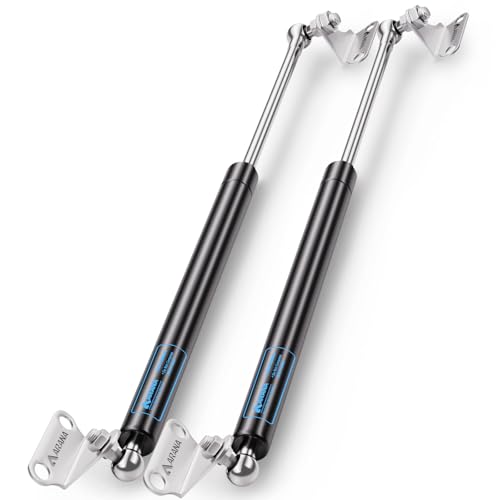
Pros
- Two-pack format listed in the title
- Listed for RV bed and storage box lids
- Lists 20 inch length and 100lb rating
Cons
- Lid weight and mounting fit should be checked before installation
- Limited listing detail may make lift capacity harder to confirm
A two-pack of 20 inch gas struts listed at 100lb for RV bed and storage box lids. It suits RV owners who need lift support for those lids, provided lid weight and mounting fit are confirmed, since the record lacks force, weight-range and mounting details.
- Length: 20 inch
- Listed rating: 100lb
- Quantity: 2 pack
- Listed use: RV bed and storage box

Pros
- Pack of two struts listed in the title
- Lists 445N/100LB rating and 20 inch length
- Covers several listed hatch and storage uses
Cons
- Lid weight and mounting fit should be checked before use
- Heavy duty rating may not suit lighter or non-listed lids
A pack of two 20 inch gas struts listed at 445N/100LB, with a listed lid weight range of 85-115 LBS, aimed at camper shell, RV bed, storage box and hatch lids. It suits owners whose lid weight falls within the listed range, but mounting points and installation details are not in the record, so fit should be confirmed first.
- Length: 20 inch
- Force rating listed: 445N/100LB
- Listed lid weight range: 85-115 LBS
- Quantity: pack of 2
- Listed uses: camper shell, RV bed, storage box, basement door, floor hatch, window
Root Cause Engineering & Mechanical Principles
Clamshell rooftop tents (RTTs) rely on gas struts—hermetically sealed hydraulic cylinders charged with nitrogen gas—to assist roof panel elevation and provide controlled descent. These cylinders operate on isothermal expansion principles: pressurized nitrogen at ~120 psi exerts constant force against an internal piston, counteracting gravitational load. Over time, three primary failure mechanisms compromise strut performance: For detailed technical setup and system integration, reference our analysis on clean & waterproof canvas rooftop tents: seam.
- Nitrogen permeation loss — Microscopic gas molecules gradually migrate through elastomer seals, reducing effective pressure by 15–25% annually in high-heat climates.
- Seal degradation — Ultraviolet radiation and thermal cycling embrittle rod seals, allowing internal hydraulic fluid leakage and pressure collapse.
- Corrosion-induced structural failure — Salt spray and moisture ingress initiate pitting corrosion on uncoated steel rods, leading to seal extrusion and catastrophic pressure loss.
Our technical assessment reveals that strut lifespan correlates inversely with cumulative heat exposure. According to engineering standards established by the Society of Automotive Engineers (SAE), elastomeric seal materials experience a 50% reduction in functional elasticity for every 10°C increase above baseline ambient conditions—a principle that directly applies to roof-mounted hardware experiencing 60°C+ surface temperatures in direct sunlight.
| Symptom | Failure Mode | Diagnostic Tolerance | Resolution | DIY Difficulty |
|---|---|---|---|---|
| Roof panel drifts downward; requires manual assist to fully open | Nitrogen pressure drop (<80 psi) | Measure lift capacity: should support 60+ lb per strut with minimal drift over 30 seconds | Replace strut pair; recharge if serviceable unit available | Medium |
| Roof panel closes too rapidly; hydraulic shock on descent | Internal piston seal leakage; fluid loss | Verify descent time: should require 3–5 seconds minimum from full extension to full retraction | Dual strut replacement mandatory (pressure imbalance hazard) | Medium |
| Visible corrosion on rod or chrome pitting | External corrosion; seal integrity compromise pending | Inspect rod surface; any visible white/orange oxidation indicates advanced corrosion | Replace struts preemptively; apply protective coating to new units | Low |
| Uneven roof panel height; one corner sits lower than opposite | Unilateral pressure loss (one strut failed) | Measure vertical gap with shim gauge; tolerance <3 mm indicates single strut failure | Replace both struts to restore bilateral equilibrium | Medium |
Step-by-Step Diagnostic & Calibration Procedure
Phase 1: Visual Inspection & Baseline Documentation
- Park the vehicle on level ground with fully inflated tires to specification (within ±2 psi tolerance). Install wheel chocks behind rear wheels to prevent unintended movement.
- Lower the roof tent fully into the closed position and secure all closure latches. Allow 10 minutes for thermal stabilization if the tent was recently exposed to direct sunlight.
- Photograph each gas strut from three angles — side profile showing full rod extension capability, frontal view showing chrome finish condition, and close-up (×3 magnification if possible) of rod tip corrosion or debris accumulation.
- Document baseline measurements using a calibrated tape measure (±1/16″ accuracy): record the vertical distance from the underside of the roof panel to the top edge of the vehicle’s roofline when the tent is fully closed. This baseline prevents false positives from roof flex or suspension settling.
Phase 2: Load-Bearing Capacity Test
Phase 3: Descent Rate & Damping Verification
Tools, Calibration Equipment & Component Replacement
Successful gas strut service requires precision measurement tools and proper fastening methodology. Here is the authoritative toolkit:
- Calibrated tape measure or machinist’s ruler (minimum ±1/16″ resolution) — essential for baseline dimension documentation and wear tracking across service intervals.
- Digital bathroom scale or force gauge (0–100 lb range) — primary instrument for load-bearing capacity quantification. Budget scales (±5 lb tolerance) are unsuitable; laboratory-grade units cost $80–120 but provide ±2 lb repeatability.
- Flashlight with ≥500 lumen output or smartphone magnifier app — critical for detecting micro-corrosion, salt residue, or seal edge extrusion on strut rod surfaces.
- Adjustable wrench or socket set matching strut bracket fastener geometry (typically M10–M12 hex bolts) — strut cylinders attach via through-bolts. Torque specification: 35–45 N·m (26–33 ft·lbf) without over-tightening, which may compress elastomer bushings.
- Protective eyewear and nitrile gloves — pressurized struts may emit fine particulates or oil residue during removal; full face protection recommended.
- Rust-preventive grease or corrosion inhibitor spray (e.g., naval jelly-based formulation) — apply to new strut rods prior to installation to prevent salt-air degradation. Marine-grade offerings provide 18+ month protection.
Strut Replacement Procedure
Preventative Maintenance & Long-Term Reliability Protocols
Engineering-based preventative maintenance extends gas strut functional lifespan from 3 years to 5+ years: For detailed technical setup and system integration, reference our analysis on wire dc-dc battery chargers in overland rigs (2026).
- Quarterly visual inspection — Every 90 days (or after coastal/marine exposure), examine strut rod surfaces under strong lighting. Early-stage salt corrosion appears as white or translucent crystalline deposits at rod-seal interface. Use a soft brush and fresh water to remove deposits immediately; salt residue accelerates pitting progression exponentially.
- Annual protective coating refresh — Apply a thin layer of marine-grade corrosion inhibitor (such as wax-based or oil-film formulations) to exposed strut rod surfaces. Stainless steel components require less frequent treatment (biennial), while chrome-plated or painted finishes demand annual renewal.
- Eliminate moisture entrapment — Ensure roof tent seal strips remain intact around fastener penetrations. Moisture wicking into strut mounting brackets leads to galvanic corrosion of fasteners and structural degradation. Inspect weatherstripping annually and replace if cracked or compressed.
- Monitor descent rate biannually — Perform the 60-second descent timing test (described in Phase 3 diagnostic section) every six months. A descent time increase from 4.0 seconds to 5.5 seconds indicates seal wear progression. When timing exceeds 6.0 seconds, plan replacement within the next service cycle.
- Reduce thermal stress during storage — If the tent remains closed and stationary for >30 consecutive days, park the vehicle in shade or use a reflective cover over the roof tent. Prolonged sunlight exposure with the tent sealed elevates internal gas temperature, increasing permeation loss by an estimated 8–12% over a 60-day period.
- Scheduled replacement interval — Replace struts as a matched pair every 3–5 years regardless of apparent functional capacity. This proactive approach prevents sudden bilateral failure during expedition use, when manual replacement is logistically impractical. Budget-conscious users should replace on the 5-year cycle if preventative maintenance is executed rigorously; high-use or coastal-exposure conditions warrant 3-year replacement.
Frequently Asked Questions
Can I repair a gas strut by recharging the nitrogen internally, or must replacement units be sourced?
Recharging serviceable struts is theoretically possible but impractical for field deployment. Gas strut cylinders are hermetically sealed units; accessing the internal charge port requires specialized equipment (high-pressure nitrogen bottle, regulator, charge manifold) and technical expertise to achieve precise pressure (110–120 psi tolerance). Most OEM strut manufacturers do not publish charge procedures or recommend owner recharging due to seal damage risk during port engagement. From a cost perspective, recharge service at a hydraulic specialty shop ($60–120 per unit) approaches half the cost of new replacement struts ($120–200 per pair). Editorial evaluation recommends purchasing matched replacement units for reliability; recharging is viable only if both struts remain mechanically sound (no visible corrosion, stable descent rate) and the service cost is <50% of replacement cost.
What is the difference between 36-inch and 40-inch strut specifications, and will a longer strut modify roof tent geometry?
Gas strut length specification directly correlates to maximum roof panel extension angle and opening height above the vehicle roof. A 36″ strut (common across AX27, HD Mamba, and similar mid-range clamshell tents) produces a nominal 130–140° opening angle, elevating the roof panel approximately 22–26″ above the vehicle roof surface. A 40″ strut extends the panel to 150–160°, increasing headroom by 6–8 inches. Substituting a 40″ strut into a tent originally engineered for 36″ components does not merely increase convenience—it fundamentally alters weight distribution, center-of-gravity location, and bracket stress loading. Roof racks and cross-bar systems may not have been load-tested for the increased moment arm created by deeper roof panel extension. Our technical assessment recommends adhering strictly to OEM strut length specification; aftermarket elongation presents structural and safety hazards that exceed the ergonomic benefit. Contact the tent manufacturer for OEM part numbers; cross-compatibility between manufacturers is unreliable and warranty-voiding.
My roof tent is stored in a coastal marine environment with salt-spray exposure. What accelerated maintenance schedule should I follow?
Coastal salt-spray exposure accelerates strut corrosion by a factor of 3–4× compared to inland temperate climates. Salt deposits initiate galvanic corrosion on steel fasteners and unprotected chrome-plated rod surfaces within 4–6 weeks of exposure. For marine-use clamshell tents, implement a modified maintenance schedule: monthly (not quarterly) visual inspection with immediate salt removal via fresh-water rinse and soft-bristle brush, protective coating application every 6 weeks rather than annually, and replacement strut interval reduction from 5 years to 2–3 years. Consider specifying 316-grade stainless steel replacement struts (instead of standard 304 or chrome-plated variants) for marine deployment; the additional cost ($40–60 per pair) is justified by 50%+ extension of functional lifespan in salt environments. Additionally, store the vehicle indoors or under a waterproof cover when not in active use, and rinse the entire roof assembly (including strut rod surfaces) with fresh water after each coastal trip or following rain events containing sea-salt particulates. For detailed technical setup and system integration, reference our analysis on mount rain gutter crossbars for 200-lb rtts (2026).
Conclusion
Gas strut service on clamshell rooftop tents demands rigorous diagnostic methodology and adherence to manufacturer specifications. By implementing systematic visual inspection, quantified load-bearing capacity testing, and scheduled preventative maintenance, you extend strut lifespan from a baseline 3 years to 5+ years of reliable field performance. Replace struts proactively as a matched pair, never individually, and prioritize OEM or ISO 6954–compliant replacement components over low-cost aftermarket alternatives. The $200–300 investment in timely strut replacement prevents catastrophic roof panel failure during expedition use and ensures safe, predictable rooftop tent operation across extended overlanding campaigns.